
From Chaco Canyon to the Arctic, BAAJA would make the Trump administration’s drilling, mining, and logging approvals nearly impossible to undo
The <href=”https://www.congress.gov/bill/119th-congress/senate-bill/5653″>Bipartisan American Affordability and Jobs Act is moving toward a vote in the Senate. Its sponsors are selling it as a fix for America’s antiquated electricity transmission system, and provisions in the bill would help build out the grid. But the bill, as currently written, also contains a number of dangerous provisions that would lock in the Trump administration’s attacks on our most vulnerable public lands.
What’s most at risk?
In New Mexico, the bill would lock in new oil and gas leases around Chaco Canyon. It could also lock in uranium mining plans around Chaco, Mount Taylor, and in the Chama watershed. It would lock in permits for the 522-mile Desert Southwest Pipeline, which would carve through Otero Mesa, a desert grassland home to more than 1,000 native species and thousands of archaeological sites.
In Utah, prospectors have filed more than 110 mining claims since Trump cut Bears Ears and Grand Staircase-Escalante national monuments by roughly 90 percent, and BAAJA could lock in any mining plans approved by the Trump administration inside the land Trump excised from the monuments. Valar Atomics’ Project Beehive would put 456 nuclear reactors and waste repositories on public land in central Utah, and BAAJA would lock those in if they’re approved before Trump leaves office.
In Arizona, any federal permits issued to Resolution Copper’s mine at Oak Flat would become nearly untouchable.
In California, the bill could lock in mining approvals across some of the state’s most treasured desert and mountain landscapes, from inside Mojave National Preserve to Music Valley, on the doorstep of Joshua Tree National Park, to Conglomerate Mesa next to Death Valley and Hot Creek in the Eastern Sierra. It would also shield the Trump administration’s permit for Sable Offshore to restart oil pipelines along the Santa Barbara Channel that were shut down after the 2015 Refugio oil spill.
In Nevada, the bill could shield the Townsite data center outside Boulder City, the first AI data center approved on public land, if the Trump administration approves it.
In Colorado, it would lock in any oil and gas leases the administration sells on the Roan Plateau, where an upcoming lease sale includes over 4,600 acres atop a plateau that holds elk calving grounds and native trout habitat.
In Minnesota, the bill would shield any leases the administration issued to Twin Metals to mine upstream of the Boundary Waters, threatening the country’s most-visited wilderness area.
In Alaska, BAAJA would lock in oil leases on the coastal plain of the Arctic National Wildlife Refuge and around Teshekpuk Lake in the Western Arctic, as well as the Ambler Road, which the Trump administration approved and which would run through Gates of the Arctic National Park and Preserve. Finally, it would lock in any old-growth timber sales held by the Trump administration in Alaska’s Tongass National Forest once the administration’s Roadless Rule repeal is complete.
Our interactive map pinpoints these landscapes and explains exactly how they are threatened by BAAJA’s anti-public land provisions. This is not an exhaustive list. Almost all public land that lies outside of national parks or other permanently protected areas could be put at risk by BAAJA.
Dangerous provisions
Section 1401 of the bill bars federal agencies from revoking, suspending, or changing any permit in effect on or after September 16, 2026. The bill allows only five exceptions: a court order, fraud, the permit holder’s violation of the law or the permit’s terms, a request from the permit holder, or an urgent threat of harm based on new information. An agency that wanted to reverse an approval on public lands would have to prove that one of these applies by “clear and convincing evidence.” That’s a much higher bar than agencies currently face when trying to unwind the harmful actions of a previous administration.
Under Section 1401, if a project developer sued and the agency couldn’t meet that bar, a court would have to restore the previously approved permit and order the government to pay the developer 25 to 50 percent of what it had already spent on the project, from surveys and engineering to equipment and construction. UC Berkeley law professor Eric Biber calls this provision “a stealth repeal of a wide swath of federal regulatory law.” The Wilderness Society calls it “the final nail in the coffin for threatened landscapes.” Essentially, Section 1401 gives the Trump administration a generous runway of just over two years to lock in drilling, mining, and other development on public lands.
The environmental reviews that agencies do before issuing permits would be stacked in developers’ favor, too. Under Section 1106, an agency would have to toss out any alternative that doesn’t meet the developer’s own goals, so options like a smaller mine or a different pipeline route might never be studied. Agencies also wouldn’t have to consider any new science published after a review began, and they couldn’t delay a decision to wait for updated scientific analysis. The public would get a comment window of 45 to 60 days, which could be extended only if the developer agreed. If agencies disagreed over a project, the developer could take the dispute to the White House Council on Environmental Quality, whose decision would be final, could not be challenged in court, and could count as satisfying consultation requirements under other laws. And once a final review was done, agencies would have just 45 days to sign off on it.
The courts also wouldn’t be much help if BAAJA passes. Under Section 1110, a judge who finds that a federal land management agency skipped or botched an environmental review for a project on public land could not cancel the permit or stop the project from moving forward. The judge could only order the agency to redo the review, while drilling, mining, or logging continued. And even if the finished review revealed serious harm, Section 1401 would bar the agency from revoking or changing the permit. Former Council on Environmental Quality general counsel Justin Pidot says this reduces a court order to redo an environmental review to “essentially an empty paperwork exercise.”
Section 1402 makes it much harder for a future president to pause approvals for activities like drilling, data center construction, or coal mining on public lands. It says that if an administration slowed permits for a category of projects—like oil and gas drilling proposals—compared with the previous five years, developers could sue and collect 50 to 100 percent of their expected construction costs from taxpayers. For a president taking office in 2029, that baseline would be the Trump years.
Section 2215 would make it much easier for mining companies to dump waste rock and build roads on public land outside their claims. In 2022, a federal appeals court blocked Arizona’s Rosemont copper mine from dumping waste rock and tailings on over 2,000 acres of national forest land, ruling that the company’s claims there were invalid because no valuable minerals had been found on them. BAAJA would effectively reverse that ruling, letting companies occupy public land for waste whenever it is “reasonably necessary” to their operations, which Earthworks’ Aaron Mintzes says would give miners “a nearly unlimited amount of public lands for their waste dumps.”
Section 2301 would rewrite the National Historic Preservation Act, taking power away from Tribes. Under BAAJA, agencies could map out the area a project affects without consulting Tribes at all, and a Tribe would have just 30 days to object to an agency’s findings. If a Tribal preservation office missed a review deadline, the Interior Department could take over its work, which Tribal organizations call “deeply paternalistic.” Nine national and regional Tribal organizations, including the National Congress of American Indians, the Native American Rights Fund, and the National Association of Tribal Historic Preservation Officers, have registered their “strong opposition” to the bill as written.
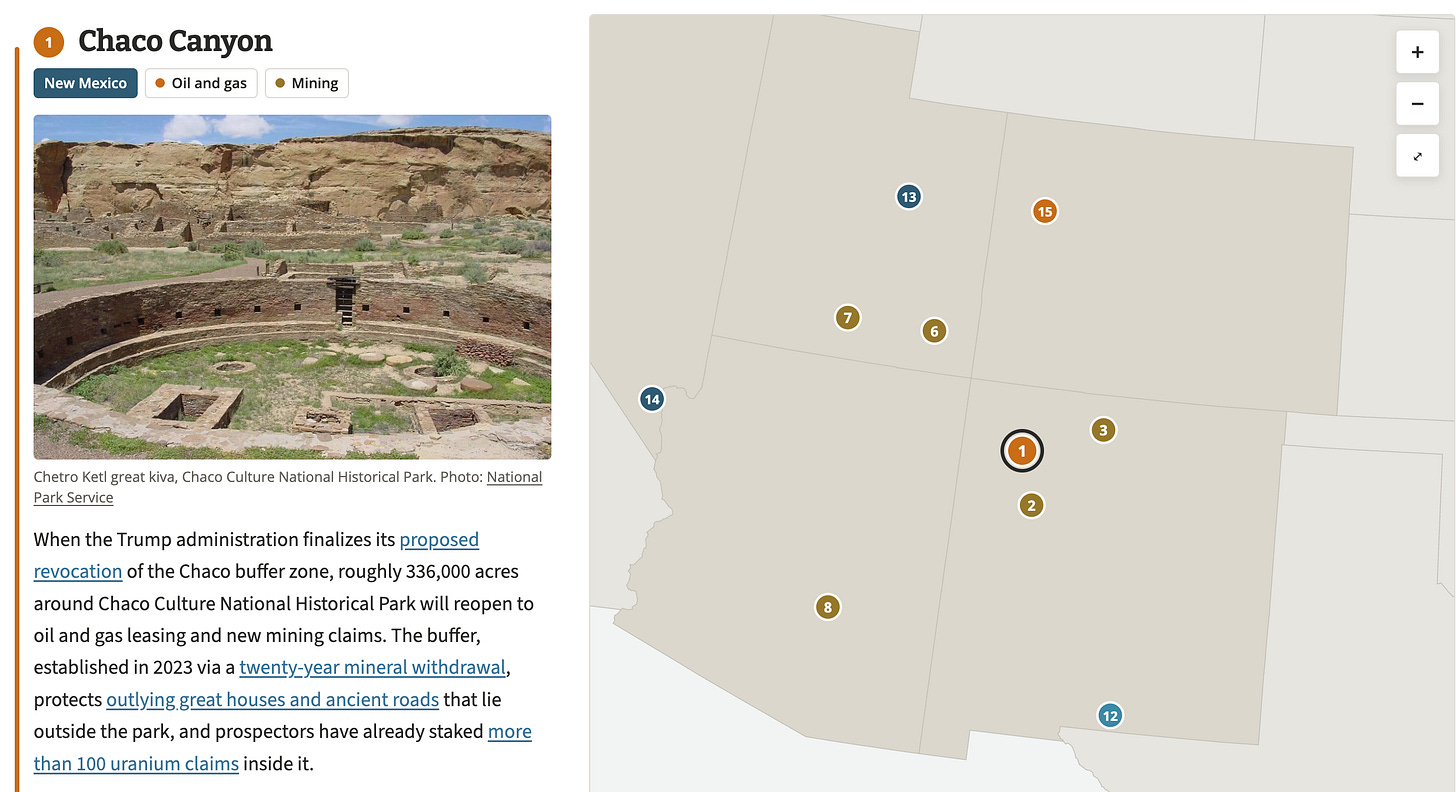
Explore the interactive map
Data center threat
The bill could also help protect the data centers the Trump administration wants to build on public land. The Bureau of Land Management has received applications for at least 16 more data center proposals, yet it has not formally weighed whether data centers are a legal use of public land nor where they should be allowed to be built, if so. The administration sought to make an end run around federal law in approving its first data center on public land, an 80-acre data center near Boulder City, Nevada, by simply swapping out a solar farm’s right-of-way application for a data center without collecting public comment or conducting a new environmental review. An Interior department judge froze that project in September, and BLM has since asked the judge to set aside its approval. Under BAAJA, approvals like that would be much harder to unwind. Because Section 1401 doesn’t define “project,” a data center right-of-way could be locked in the day it is approved. And if a future administration put a pause on data center approvals in order to study their impacts, developers could collect up to 100 percent of their expected construction costs from taxpayers under Section 1402 of the bill.
Locking in Trump’s DC makeover
BAAJA’s reach extends beyond the West. In Washington, DC, President Trump is renovating landmarks on public land. The National Park Service, which manages much of the capital’s public land, is carrying out many of these plans. At East Potomac Park, crews cut down at least 400 trees on the historic public golf course over a holiday weekend as Trump pushes to turn it into a venue for major championships. On Park Service land near Arlington National Cemetery, Trump plans to build a triumphal arch. And at the Kennedy Center, a federally owned memorial to President John F. Kennedy also located on public land, Trump is planning a massive renovation that he says could strip the building down to its steel frame.
Opponents are fighting each project in court, largely under the National Environmental Policy Act and the National Historic Preservation Act. In October, U.S. District Judge Ana Reyes halted the golf course work after finding that officials had rushed the tree-cutting plan to meet Trump’s demands for speed, then extended that order into a preliminary injunction. The District of Columbia and Virginia have sued to block the arch. Historic preservation groups have sued over the Kennedy Center project as well.
BAAJA could make it much harder to stop these projects. Under Sections 1110 and 2301 of the bill, a judge who found that the Park Service had skipped or botched an environmental or historic preservation review could not halt the project. The judge could only send the decision back for more study while chainsaws, bulldozers, and demolition crews kept working. By the time the agency finished its new review, the damage would be underway, and the Park Service could simply issue a new decision allowing the work to continue.
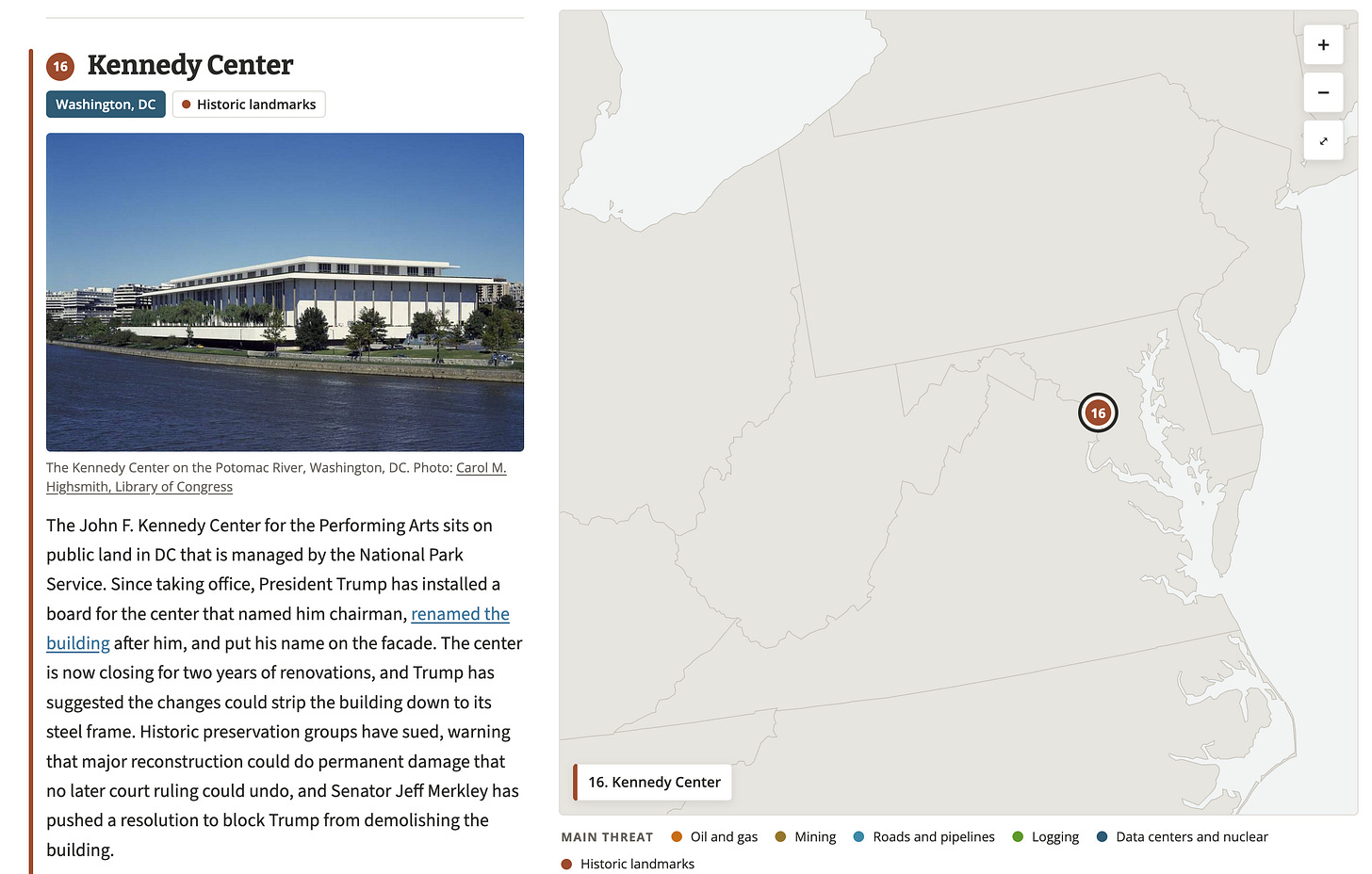
Explore the interactive map
What BAAJA would bar
Looking back, Colorado’s Thompson Divide shows what’s at stake if BAAJA passes as written. The 220,000-acre stretch of the White River National Forest draws more than 10,000 big game hunters a year and shelters native cutthroat trout. Beginning in the 1990s, the federal government sold oil and gas leases there that ranchers, hunters, and local governments fought for more than a decade. After a review found the leases had been improperly issued, the Obama administration canceled 25 of them, covering 33,000 acres. The main leaseholder, SG Interests, sued, and in 2018, the government settled for $1.5 million, ending the challenge and leaving the leases void.
Under BAAJA, that would not have been possible. Section 1401 would have barred the Interior department from canceling the leases unless a court ordered it, and Sections 1110 and 2301 bar courts from ordering the government to cancel a lease over a flawed environmental review. Even if the Interior department could have found a way to cancel the leases, the leaseholder could have sought 25 to 50 percent of the costs it had spent on them, instead of a negotiated amount.
Every leasing decision the Trump administration rushes through around Chaco, in the Arctic, or on the Roan Plateau could be just as flawed as the now-cancelled Thompson Divide leases. If BAAJA becomes law, a future administration that wants to overturn them would be essentially powerless to do so without a court order.
A false choice
As it’s currently written, BAAJA presents a false choice between lowering carbon emissions and protecting our most vulnerable public lands and cultural landmarks. Handing even more power to destroy our public lands to the Trump administration is clearly not worth the modest reduction analysts estimate BAAJA might have on climate-warming emissions.
It’s also worth noting that the climate math behind these analyses leaves public lands out. Rhodium Group’s modeling, which projects relatively modest emissions cuts, “does not include an attempt to reflect the permit certainty provisions of the bill.” Analyses by Resources for the Future and for the Solar Energy Industries Association model only the power sector. None counts the emissions from the drilling, mining, and gas-powered data centers the bill would lock in on public lands.
Right now, BAAJA contains a lopsided deal that would unnecessarily lock in decades of oil and gas infrastructure and allow corporations to pillage our public lands for their own profit. The incoming Congress will have significantly more leverage to pass a bill that speeds the grid buildout and unlocks stalled wind and solar projects, without sacrificing America’s public lands.