
The BLM is using a shortcut that could come back to bite the AI industry
In June, the Bureau of Land Management approved the first AI data center on America’s public lands. It didn’t write a new rule, hold a public comment period, or prepare a new environmental review. It amended a right-of-way BLM granted in 2023 for a solar farm near Boulder City, Nevada, and let the developer, Townsite Solar 2, swap out its solar panels for an 80-acre data center with a substation, battery storage, and biodiesel backup generators—a very different project with different environmental impacts and energy needs. Boulder City had already voted not to approve the project on city land, so the developer attempted an end run around the community by pivoting to public land.
In September, an Interior department administrative judge froze the approval, finding BLM likely acted “arbitrarily or capriciously” when it treated a solar farm and a data center as substantially the same project. Weeks later, the BLM asked a judge to set aside the approval to allow the agency to reconsider the application. Meanwhile, the agency has received applications for at least 16 more data center proposals, following a July 2025 executive order directing the Interior department to identify national public land for data centers. The BLM is reportedly now considering approving one of those applications, a 3,700-acre data center campus on public land outside of Twin Falls, Idaho.
The legal problem with putting data centers on public lands runs deeper than one rushed review. BLM’s governing law, the Federal Land Policy and Management Act of 1976, lists what rights-of-way on public lands can be used for: water systems, pipelines, electric generation and transmission, communications, roads, and railroads. Data centers aren’t on the list. To approve them, BLM would likely have to rely on a catch-all allowance in the law for “other systems or facilities which are in the public interest.” A warehouse full of servers primarily benefits private industry, not the general public. For industrial and commercial uses like that, BLM uses a different tool: leases under Section 302 of FLPMA. Marinas, recreation businesses, farms, and equipment staging yards are some examples of uses BLM authorizes with leases and permits.
Right now, the Trump administration is attempting to authorize data centers through right-of-way applications, which would require stretching a provision no court has ever applied to this type of project on public lands. What’s more, the BLM has yet to formally determine whether data centers are even a legal use of public land. This is clearly the wrong approach, but is there a right one? BLM has faced new technologies before, and history illustrates how this could work.
Geothermal
In the late 1960s, no one knew whether underground steam on federal land counted as water or as a mineral. Meanwhile, California’s Geysers field was already producing geothermal electricity. Pacific Gas and Electric built an 11-megawatt plant there in 1960, running on steam from geothermal wells on private land. Developers wanted to drill on public land too, but the Interior department said it had no authority to lease it, telling Congress that geothermal steam was water governed by state law. Congress responded by passing the Geothermal Steam Act of 1970, which made geothermal a leasable resource like oil and gas. Congress revised the law in 2005, making competitive lease sales the norm and creating a plan for splitting royalties generated from geothermal energy sales with states and counties.
BLM built its geothermal program on that foundation. Companies bid on leases at auction, pay rent and royalties, and need separate approvals to drill, build a power plant, and begin commercial operation—much like BLM’s oil and gas leasing process. In 2008, BLM and the U.S. Forest Service completed a programmatic environmental review that amended 114 land use plans to determine where geothermal leasing could occur.
Data centers have none of this authorization. Congress has not addressed whether they belong on public land, BLM has not done a programmatic review mapping where they should go, and there is no structure in place to ensure data centers pay out royalties to the federal government or to the cities, states, or counties that host them.
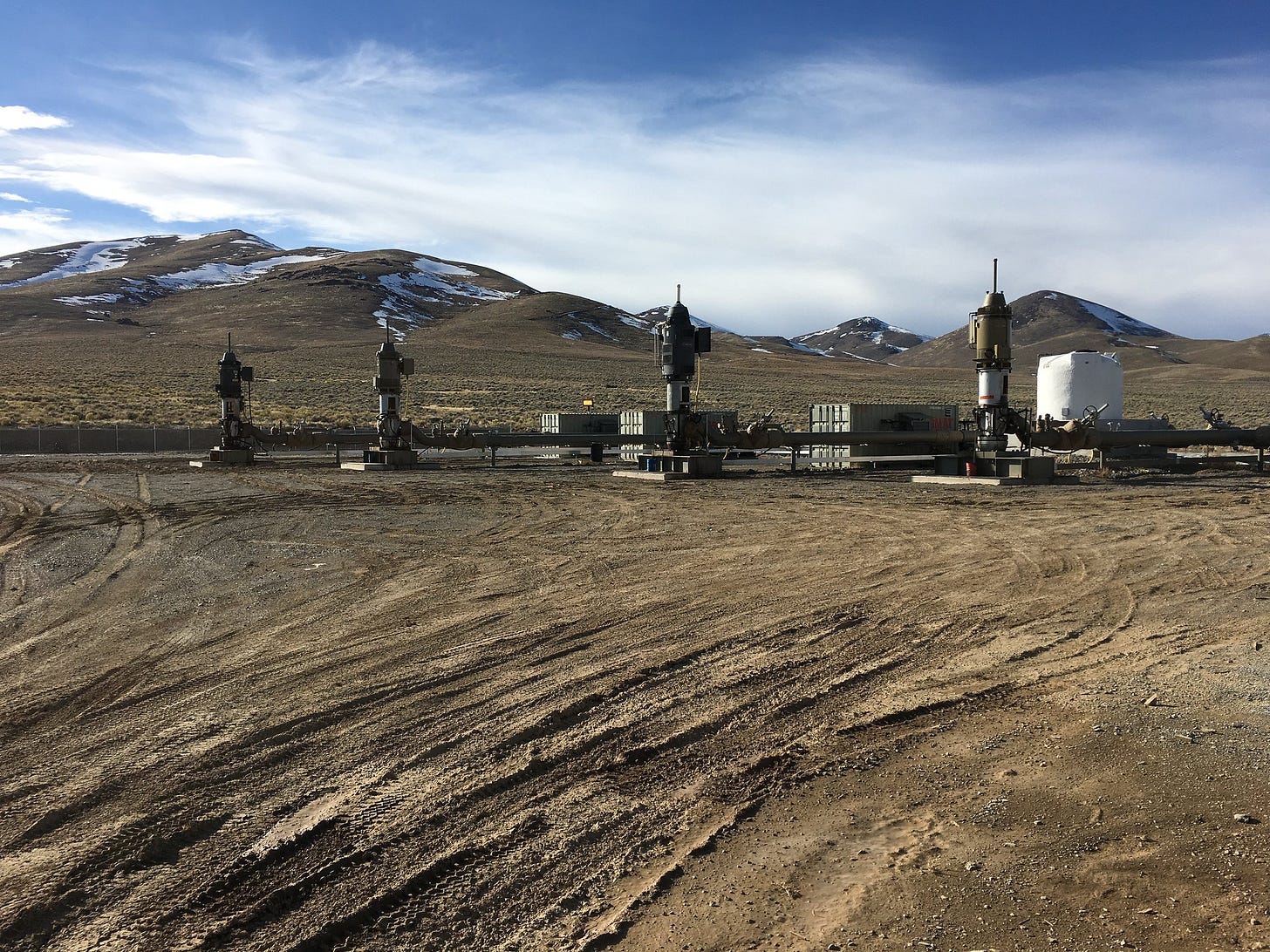
McGinness Hills, the largest geothermal complex in Nevada, has about 138 megawatts of capacity. Source: BLM/Flickr
Wind
Wind didn’t need its own statute, since FLPMA already lists “systems for generation, transmission, and distribution of electric energy” as a right-of-way use, and turbines clearly fit that description. BLM initially approved wind projects case-by-case, and by 2002 it was managing about 25 wind rights-of-way in California and Wyoming, generating roughly 500 megawatts. As interest grew, the agency issued an interim wind policy that year, then paused to create a permitting plan before allowing the industry to scale up.
In 2005, it finished a programmatic environmental impact statement that amended 52 land use plans in nine states and set rules to protect birds, bats, and other wildlife. Projects still require site-specific review, typically starting with short-term grants to test the wind before receiving full approval.
Unlike data centers, wind had a clear legal footing under FLPMA and BLM still paused to plan for it before approving projects at scale.
Solar
Solar is the closest parallel to today’s data center scramble. By 2008, about 130 applications for solar projects on BLM land had piled up and none had been approved. BLM briefly froze new applications while it studied the issue, then reversed course after industry objected, and went back to the drawing board.
That work became the 2012 Western Solar Plan, a programmatic review conducted by the Interior department along with the Department of Energy that amended 89 BLM land use plans. It sorted public land into three categories: 17 Solar Energy Zones where BLM steered development, about 19 million acres of “variance” land where developers could still apply and receive extra scrutiny, and areas closed to utility-scale solar energy development. In 2016, BLM adopted rules for competitively leasing land inside the Solar Energy Zones. An updated plan in 2024 eliminated the variance category, replacing it with more than 31 million acres open to applications, mostly near existing transmission lines. Congress set targets along the way for solar development on public lands but never had to authorize solar, because FLPMA explicitly names electric generation as a valid use of public lands.
In this case, BLM faced a flood of solar applications, then spent years doing planning and collecting public comment to figure out how to handle them. Data center applications are creating a similar pressure on the agency, and the Trump administration’s answer has been to approve the first one through a modified solar permit, a lazy strategy that quickly failed. If data centers are determined to be a valid—and appropriate—use of public lands under FLPMA, BLM must follow a similar planning process to develop a fair and responsible structure for them.
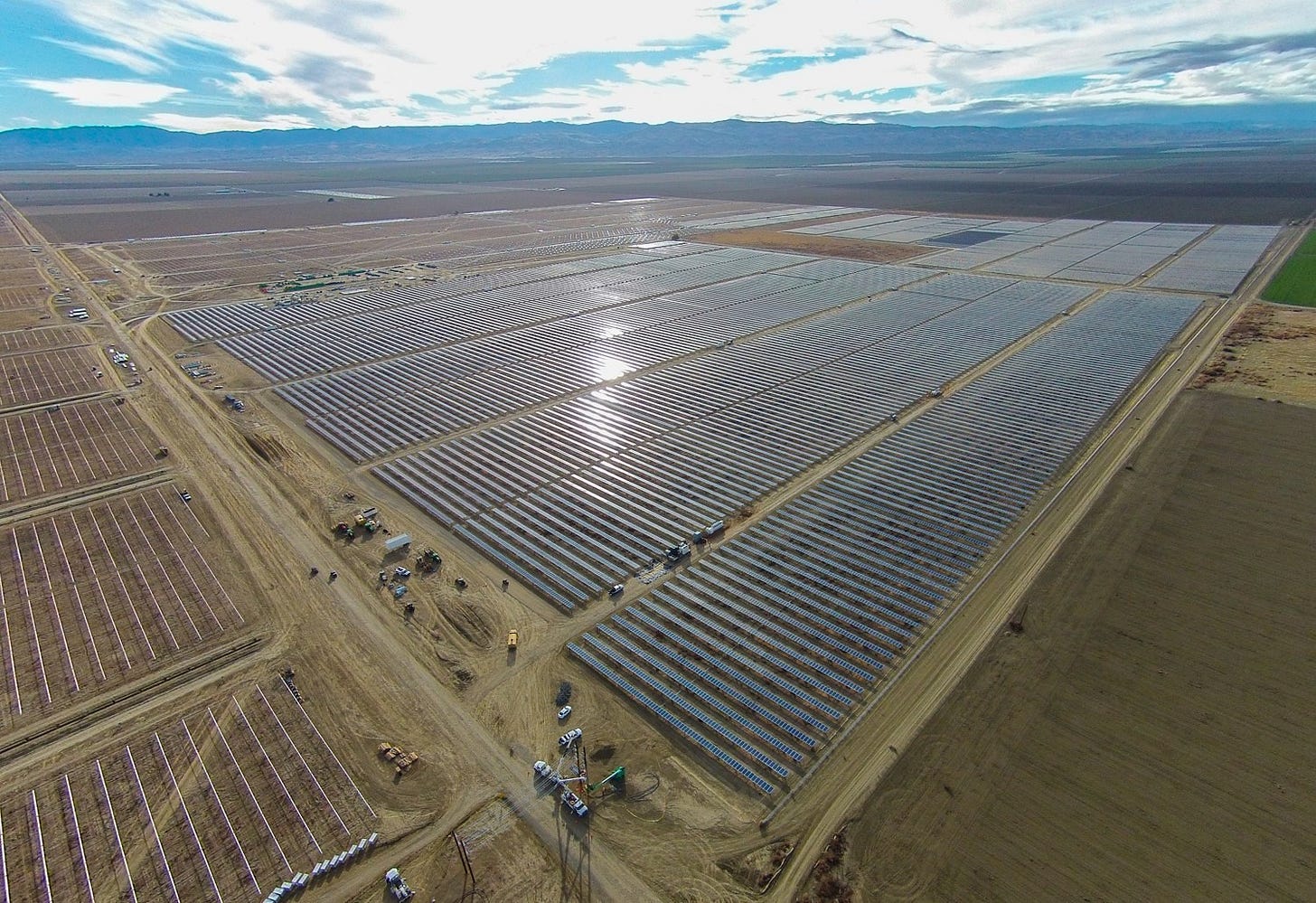
This solar array in California is similar to the approved Crimson Solar Project, located on BLM land in California. Photo courtesy of Recurrent Energy. Source: BLM/Flickr
Are data centers even a legal use of public land?
Wind and solar energy development each arrived on public lands with a clear legal basis under FLPMA, and BLM still paused to determine where each belonged and created processes before approving projects at scale. Congress authorized geothermal development on public lands, and BLM created a leasing system for it. Data centers have no congressional approval, no clear standing under FLPMA, and no permitting process in place. The administration would have to rely on a catch-all right-of-way provision written for “necessary” facilities “in the public interest” to approve private server farms, some powered by new natural gas plants or nuclear reactors. Whether AI data centers serve the “public interest” is an open question—but poll after poll suggests that Americans think they do not.
This raises two important questions. First, are data centers a legal use of public land under federal law? And second, are they an appropriate one? If the courts rule that data centers don’t fit FLPMA’s definition of a legal use, every approval issued by BLM would be invalid, and a future administration could revoke them.
Interior should pause new data center approvals until both questions are answered, and the public should have a real say in determining the appropriateness of putting data centers on public lands. BLM should conduct a programmatic review to determine this, with a robust public input process, that looks at the water, energy, and habitat impacts of putting data centers on public lands and asks whether data centers are a valid and appropriate use of public lands. If the answer is no, BLM should throw out the data center applications it has already approved and stop reviewing new ones.
If the answer is yes, BLM would still have to revise land use plans across the country before it moves forward with approving individual data centers. Each BLM field office has a Resource Management Plan that designates where pipelines, power lines, and energy projects can go. BLM would need to amend these individual land use plans to determine where data centers can go through a transparent public process before attempting to approve any more.
If the Trump administration begins revising land use plans before engaging in a high-level review to determine if data centers are a legal and appropriate use of public land, any data center approvals that follow would still be in legal limbo.
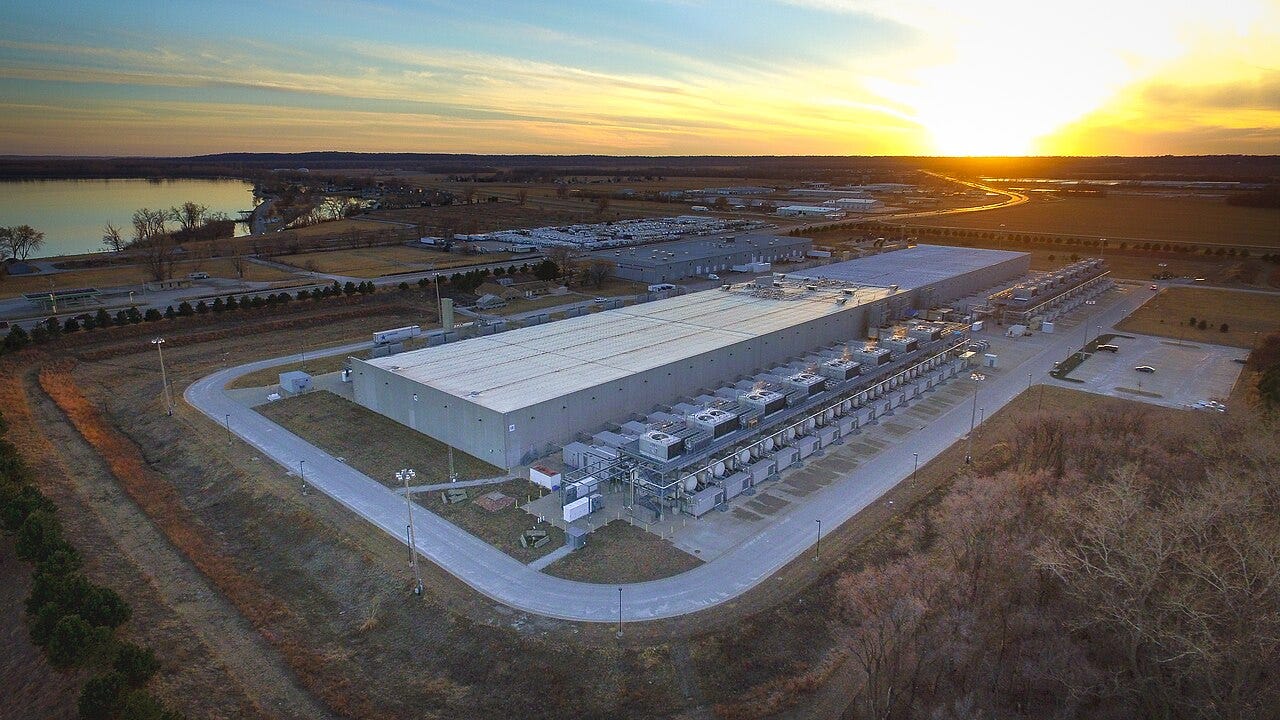
Aerial view of the Google Data Center in Council Bluffs, Iowa. Source: Chad Davis/Wikimedia

The permitting bill could lock it all in
Much of this may not matter if the Senate permitting bill passes. The Bipartisan American Affordability and Jobs Act is expected to come up for a vote on the Senate floor after the November election and would bar agencies from revoking, suspending, or altering any project, action, or federal authorization or permit in effect on or after September 16, 2026, except under extremely rare circumstances proven by “clear and convincing evidence.” What counts as a project, action, authorization, or permit under the bill is extremely broad, so a data center approved on public land under the current ad hoc process BLM is using could be locked in for good, unless it’s ruled by a court to be an illegal use of public land.
The permitting bill could also make a moratorium on data centers prohibitively expensive. As it’s written, if a future administration slows an entire category of projects, developers could collect 50 to 100 percent of their expected construction costs from the Judgment Fund, a Treasury account that pays out without a vote of Congress. A pause on data center application approvals while Interior weighs whether they belong on public lands is the kind of slowdown that could trigger those payments.
Finally, the bill would limit the public’s ability to push back against data centers. Challengers would have only 150 days to sue, and a court that finds a BLM environmental review for a data center is flawed could order it to be redone, but couldn’t halt construction from moving forward. The bill would also rewrite the National Historic Preservation Act so agencies like the BLM judge what counts as harm to sacred sites and consult Tribes only after reaching their conclusions.
The stakes are incredibly high, and things are moving quickly. Trump’s Interior department needs to stop all efforts to approve data centers until it determines whether they are an appropriate and legal use of public lands, and if so, how to assess and approve them responsibly, ensuring communities both have a say in whether data centers end up in their backyards and receive financial benefits from them. If the department fails to do so, it could face a massive wave of public backlash as Americans realize they can’t rely on the federal government to protect their communities or their national public lands.
Feature image: The Utah Data Center is a 1.5 million-square-foot National Security Agency facility located at Camp Williams in Bluffdale, Utah; Source: ParkerHiggins (Electronic Frontier Foundation)/Wikimedia
