
Co-written by Lilly Bock-Brownstein, Rachael Hamby, and Aaron Weiss
Introduction
Increasing fossil fuel production on public lands. Gutting federal agencies that oversee national parks and forests. Removing protections for Alaska’s lands and waters. Limiting environmental reviews and undermining the Endangered Species Act. These are just a few of the extremely unpopular actions called for in the Heritage Foundation’s Project 2025 “Mandate for Leadership” report. They are also all actions taken by the Trump administration in 2025—one of the worst years on record for national public lands.
On the campaign trail, President Donald Trump was quick to dismiss and disavow Project 2025 because of its immense unpopularity among voters. Project 2025 is a policy plan released in 2022 by the Heritage Foundation, a right-wing think tank, for a future Republican presidency. A poll by NBC conducted in September 2024 found that just seven percent of registered Republicans viewed the plan positively. Trump himself described the plan as “absolutely ridiculous” and said he was “not going to read it.” Yet his actions in the past year have hewn incredibly close to Project 2025’s recommendations. A CNN analysis of all 53 executive orders and actions taken by Trump during his first week in office found that over two-thirds aligned with Project 2025.
This analysis of President Trump’s actions over the course of 2025 finds that he has implemented, or begun to implement, over 80 percent of actions pertaining to public lands recommended by Project 2025. To come up with this number, the Center for Western Priorities reviewed Project 2025 for actions related to public lands. This included looking at the chapters on the Interior department, the Department of Agriculture, which oversees the U.S. Forest Service, and various other chapters related to water, permitting, and endangered species. Ultimately, our team identified 70 discrete actions in the plan related to public lands. We then assessed whether the administration has fully implemented the recommendation, begun to implement it, or has not yet begun to implement it. Each action was assigned one point, regardless of its relative impact, in order to keep the scoring as objective as possible.
Methodology:
Many of the actions called for in Project 2025 have been implemented by the Trump administration via executive orders and rulemaking processes that are underway but not complete. We categorized these actions as “in progress” if President Trump, Interior Secretary Doug Burgum, or Agriculture Secretary Brooke Rollins has issued the order or begun the rulemaking process to implement the action, but the rule is not finalized. While Project 2025 is primarily focused on actions that fall fully under the purview and authority of the president and his cabinet, it also calls on the president to work with Congress to achieve some of its recommendations. We categorized these actions as “in progress” if President Trump has publicly advocated for the action but Congress has not yet implemented it. If Congress attempted, but did not pass, legislation on these actions, we considered it not yet done.
Unleashing fossil fuel production
The second Trump administration has systematically implemented nearly 70 percent of the actions related to fossil fuels our team identified in Project 2025, with another 20 percent in progress. The president has done so through a series of executive actions and legislative initiatives.
Central to this effort was Executive Order 14154, titled “Unleashing American Energy,” which President Trump signed on his first day in office. This order was followed by Interior Secretary Doug Burgum’s Secretarial Order 3418 in February, which formally rescinded Biden-era climate priorities. This fulfilled one of the primary directives of Project 2025, to “reinstate the Trump-era Energy Dominance Agenda.” These two actions effectively restored a suite of Trump-era directives, including those prioritizing federal coal leasing, “America-First” offshore energy strategies, and the removal of “undue burdens” on domestic energy production.
In an attempt to accelerate oil and gas drilling and sidestep environmental reviews, the Bureau of Land Management (BLM) issued new guidance in April setting a strict goal to process applications for permits to drill within 28 days. These rules required environmental assessments to be completed within 14 days and environmental impact statements within 28 days.
In late 2025, the BLM conducted massive lease sales across New Mexico, Wyoming, and Colorado. This expansion was accelerated by the passage of the One Big Beautiful Bill Act (OBBBA) at President Trump’s insistence in July. OBBBA mandated rolling lease sales through 2040 and significantly reduced the royalty rates that oil and gas companies pay when they extract publicly-owned oil and gas. OBBBA also requires BLM to reduce the amount of bonds that drillers must post, making it easier for them to leave taxpayers on the hook for cleanup costs. Under the OBBBA, the administration also offered 80 million acres for offshore drilling in the “BBG1” sale held in December 2025.
Project 2025 also called on the administration to restart the federal coal leasing program and accelerate mining permits. In April 2025, the Department of the Interior terminated the programmatic environmental review of coal leasing that was begun during the Biden administration, restarting coal leasing, and eventually opening 13.1 million acres of public land to coal mining in September.
Ending federal land protection
Project 2025 calls on the president to reduce or eliminate national monuments, abolish the Antiquities Act, and end the national goal to protect 30 percent of U.S. land and water by 2030 (the 30 by 30 goal). Less than 20 percent of the six actions related to ending federal land protection in Project 2025 identified by our team have been accomplished by the Trump administration so far, but nearly 70 percent are currently in progress.
On his first day in office, President Trump signed an executive order that formally rescinded the Biden administration’s commitment to the 30 by 30 goal. This was followed by several actions that rolled back conservation policies that helped support conserving more land under 30 by 30, including attempts to rescind the BLM Public Lands Rule and the Roadless Rule, and diverting funds for the Land and Water Conservation Fund (LWCF), which provides financial resources for state, local, and federal governments to acquire and protect new conservation lands.
Project 2025 also calls for reviewing all BLM resource management plans approved during the Biden administration, with the goal of reverting to older plans that did not prioritize conservation. In an unprecedented and legally questionable move, President Trump signed resolutions approving the use of the Congressional Review Act (CRA) to eliminate regional public land-use plans in several states.
Efforts to slash national monuments and destroy the Antiquities Act are quietly in progress, but not yet in full swing. In February, Interior Secretary Doug Burgum issued Secretarial Order 3418 Unleashing American Energy to comply with Trump’s Executive Order 14154, which directs Interior staff to “review and, as appropriate, revise all withdrawn public lands, consistent with existing law, including [the Antiquities Act and FLPMA].” While this review is not yet publicly underway, the administration has been working behind the scenes on this goal.
In April, reporters obtained a draft internal strategic plan framework that prioritized efforts to “assess and right-size monuments,” specifically identifying monuments such as Bears Ears and Grand Staircase-Escalante and Baaj Nwaavjo I’tah Kukveni-Ancestral Footprints of the Grand Canyon monument for review. In May, a DOJ legal official reportedly issued a memo concluding that the President has the authority not only to shrink but also completely revoke national monument designations. The memo attempts to upend a 1938 DOJ opinion which held that a president cannot abolish national monuments designated by previous presidents.
Gutting agency staffing and expertise
One of the primary goals of Project 2025 is to attack civil servants across all levels and agencies of the federal government, allowing Project 2025 mastermind and co-author Russell Vought to reshape the workforce when he took over as head of the White House Office of Management and Budget (OMB). Around 40 percent of the seven actions related to the funding and staffing of public land management agencies in Project 2025 identified by our team have been completed by the Trump administration so far, with another 15 percent in progress.
The effects of Project 2025’s personnel directives were amplified by the chaos that Elon Musk’s Department of Government Efficiency (DOGE) effort created within the Department of the Interior and the Forest Service, leading to uncertainty and mass departures across agencies.
Before he was appointed director of OMB, Russell Vought vowed to leave civil servants “in trauma”—a goal that DOGE met and exceeded across the government, especially across public lands agencies. More than 14,500 Interior department employees left the agency in President Trump’s first year back in the White House, according to data analyzed by E&E News. While Interior filled some of those positions, the overall size of the agency is 6,100 people smaller than in 2024. At the Forest Service, Office of Personnel Management data show nearly 8,900 fewer employees since 2024.
Central to this restructuring was the reinstatement of Schedule F, one of the key recommendations of Project 2025. Finalized in November 2025, Schedule F reclassified thousands of career civil servants as at-will employees who could be fired by political appointees. Implementation of Schedule F, however, is currently on hold due to ongoing litigation from public employee unions.
Project 2025 takes specific aim at mine inspectors within the Office of Surface Mining and Reclamation Enforcement and called for the Interior department to once again move the Bureau of Land Management headquarters out of Washington, DC; those goals have so far not been implemented by Interior or Congress.
Pillaging Alaska’s natural resources
Project 2025 calls for opening up millions of acres of Alaska wilderness to drilling, mining, and logging. On Trump’s first day in office, he signed Executive Order 14153 “Unleashing Alaska’s Extraordinary Resource Potential,” which implemented nearly every part of Project 2025’s plan for Alaska. Around 45 percent of the nine actions related to Alaska’s public lands in Project 2025 identified by our team have been completed by the Trump administration so far, with around 55 percent in progress.
First, Project 2025 calls on the president to reinstate a plan to open a third of the 23 million acres in the National Petroleum Reserve-Alaska (NPR-A) to drilling. This action was officially approved through a Record of Decision in late December, reverting to the previous Trump administration’s drilling plan for the NPR-A. The Trump administration is also making moves to expand the Willow drilling project within the NPR-A. BLM officials recently approved a drilling project by ConocoPhillips, the first step towards adding the two new drilling pads that Project 2025 calls for.
Project 2025 also directs the president to reinstate oil and gas leases within the 1.5-million-acre coastal plan of the Arctic National Wildlife Refuge (ANWR) that were issued under the previous Trump administration and canceled by President Biden. The Trump administration fully accomplished this by canceling the Biden-era environmental analyses that restricted leasing and reinstating the 2020 leasing program. The OBBBA mandates at least four new lease sales in the ANWR Coastal Plain in the next seven years. In December, the Senate passed a measure to use the CRA to repeal the Biden-era plan governing leasing for oil and gas development in the ANWR.
Also in accordance with Project 2025, President Trump signed a memorandum in October approving the Ambler Road Project, a 211-mile-long gravel highway through the Brooks Range in the Gates of the Arctic National Park and Preserve that would devastate the fragile arctic tundra.
Finally, Project 2025 proposes rescinding the 2001 Roadless Rule with the specific goal of increasing logging and other development in Alaska’s Tongass National Forest. The Trump administration is working toward this with a proposed rule to rescind the 2001 Roadless Rule, which would open millions of acres of national forest lands across the nation to logging and other forms of development, including over half of Alaska’s 17-million-acre Tongass National Forest.
Limiting environmental reviews
The National Environmental Policy Act (NEPA), signed into law in 1970, is often referred to as the country’s bedrock environmental law and described as a “look before you leap” statute. It requires that the government examines the environmental impacts of major federal projects or major projects on federal lands through the completion of environmental reviews. Any changes to the law itself would need to be undertaken by Congress, but President Trump has influenced how the law is implemented through the issuance of executive orders and agency rulemakings. All 10 of the actions related to limiting environmental reviews recommended in Project 2025 identified by our team have been completed or attempted by the Trump administration.
The first Trump administration made a number of administrative efforts to water down implementation of NEPA and otherwise limit environmental reviews. Project 2025 recommends that these changes, which were revoked by the Biden administration, be reinstated, and the second Trump administration has obliged.
President Trump’s “Unleashing American Energy” executive order reinstates many of these changes. Interior Secretary Doug Burgum also issued a number of secretarial orders that restore NEPA procedures from the first Trump administration, including Secretarial Order 3417 “Addressing the Energy Emergency,” which orders the Interior department to identify any and all emergency authority available to expedite energy and mineral development on national public lands; Secretarial Order 3418 “Unleashing American Energy,” which revokes many policies put in place during the Biden administration and orders the development of “action plans” to further reduce review of energy development and other activities on national public lands; and Secretarial Order 3421 “Achieving Prosperity through Deregulation,” which orders the Interior department to identify as many regulations as possible for potential rescission, and requiring that for every new regulation issued, the Interior department must identify ten regulations to rescind.
Ironically, the Trump administration’s obsession with killing the wind industry actually put it at odds with congressional Republicans seeking to reform permitting laws. Republican lawmakers were forced to amend the SPEED Act in a way that would facilitate the Trump administration’s ongoing efforts to axe renewable energy projects, undermining the technology-neutral aspirations of the bill sponsors, before it passed the House in December.
Putting endangered species at risk
In November, the U.S. Fish & Wildlife Service (FWS) announced four proposed rules aimed at changing how the Endangered Species Act is used to protect wildlife and the habitats they depend on. Two of the proposed rules implement specific recommendations from Project 2025 to change how critical habitat is designated and what criteria must be considered when evaluating areas to exclude from critical habitat. Only around 20 percent of the nine actions related to endangered species in Project 2025 identified by our team have been completed by the Trump administration so far, but around 55 percent are currently in progress.
The Trump administration also moved forward with three species-specific priorities from Project 2025. The first is the removal of grizzly bears from the endangered species list. Just before the end of the Biden administration, FWS proposed a rule revising the grizzly bear’s listing. Under the Trump administration, FWS extended the comment period. Meanwhile, legislation has been moving through Congress that would require delisting of grizzly bears. The comment period on the proposed rule closed in May and the final rule has not yet been published.
The second species-specific priority from Project 2025 is eliminating protections for gray wolves. FWS under the first Trump administration had tried to remove gray wolves from the endangered species list, but was blocked from doing so by a 2022 court order. Under the second Trump administration, FWS announced that it will not be writing a recovery plan for gray wolves, effectively refusing to take action to conserve them even though they remain on the endangered species list. Legislation is also moving through Congress to delist gray wolves.
The third species targeted by Project 2025 is the greater sage-grouse. Because of precipitous population declines, greater sage-grouse were deemed eligible for protection under the Endangered Species Act in the early 2010s. In order to avoid this action, the federal government and Western states developed collaborative land management plans finalized in 2015 with protections for the birds’ habitat in order to allow drilling and ranching to occur while avoiding the need to list the bird under the ESA. Pointing to President Trump’s “Unleashing American Energy” executive order, the second Trump administration is throwing many of these efforts out the window with the adoption of statewide resource management plan amendments in Western states that open up more sage-grouse habitat for energy development.
Prioritizing logging in national forests
Project 2025 calls for an increase in timber sales to “change the behavior of wildfire,” and says the U.S. Forest Service (USFS) should focus on proactive management of forests that “does not depend heavily on burning.” In effect, this pushes timber production on public lands as the primary means of reducing wildfire risk, while ignoring scientific evidence that commercial logging can actually have the opposite effect.
In order to increase thinning and logging, Project 2025 recommends limiting the scope of environmental reviews required by the National Environmental Policy Act and weakening the Endangered Species Act. President Trump and Agriculture Secretary Brooke Rollins have made significant progress in implementing this destructive vision for our national forests through the issuance of executive orders and the removal of protections for national forest lands. Around 40 percent of the five forest-related actions our team identified in Project 2025 have been accomplished by the Trump administration so far, while another 60 percent are in progress.
In March, President Trump issued Executive Order 14225, which underpins the administration’s plan to increase logging by defining timber production as a national security priority and setting an aggressive 25 percent increase in logging quotas for federal agencies that oversee forested land managed by the federal government, including the USFS and BLM. The order also directs agencies to exploit emergency provisions under the ESA to identify endangered species that prevent logging and exempt habitat protections for them, as recommended by Project 2025.
In April, Secretary Rollins issued an emergency order covering nearly 113 million acres of national forest land, claiming these forests are at high risk of wildfire and need to be thinned. This emergency declaration allows USFS to fast-track commercial logging projects by shortcutting environmental reviews and limiting public participation, implementing Project 2025’s call to decrease wildfire risk by increasing manual thinning and logging.
In August, the Trump administration announced it is repealing the 2001 Roadless Rule, which will open an additional 45 million to 58 million acres of previously protected national forest land to commercial timber production. While not explicitly mentioned in Project 2025, repealing the 2001 Roadless Rule facilitates the plan’s goal of increasing manual thinning in national forests, especially in Alaska’s Tongass National Forest. Finally, the administration is seeking to overhaul the ESA in order to severely limit what qualifies as protected habitat, further increasing the amount of forest land available to logging companies.
Everything else
While most of Project 2025’s public lands recommendations fall into seven main buckets, there are a handful of actions that touch on public lands but did not fit into the previous sections. In total, we identified five actions related to public lands that fall into this miscellaneous category. About 40 percent are in progress, while 60 percent have either not yet been attempted or have not been implemented due to their reliance on congressional compliance.
Project 2025 calls on Congress to enact laws permitting the BLM to humanely dispose of wild horses and burros, an extremely controversial action that Congress has so far not taken. Each year, Congress includes language in the funding bill for Interior that bars the BLM from using federal funds to kill healthy wild horses or sell them for slaughter. President Trump’s fiscal year 2026 budget proposal for Interior omitted this language, in line with Project 2025’s recommendation, but the House Appropriations committee included the language in its FY2026 funding bill, reaffirming these protections.
Project 2025 also calls on President Trump to reinstate a presidential memorandum on “Promoting the Reliable Supply and Delivery of Water in the West.” The original memorandum was issued by President Trump in 2018 and called on federal agencies to reduce regulatory barriers to improve the delivery of water and hydropower infrastructure in the West. He issued a small update to this memorandum in January 2025 that only applies to California, called “Putting People over Fish: Stopping Radical Environmentalism to Provide Water to Southern California.” It ordered the secretaries of Commerce and Interior to restart federal efforts to divert more water from the Sacramento-San Joaquin Delta in Northern California to Southern California to meet human water needs.
Less than two weeks after issuing the “People over Fish” order, President Trump ordered the release of water from reservoirs in northern California so it could flow to the southern part of the state for firefighting and other needs, framing it as a political win against what he called excessive environmental restrictions. But local officials and water managers say the water was never physically routed to Southern California and instead flowed into riverbeds far north of Los Angeles with no infrastructure to deliver it to the fire-affected areas, causing flooding risks for nearby communities.
Project 2025 calls on the president to seek congressional reauthorization of the Land Buy-Back Program for Tribal Nations, which ended in 2022. The program provided $1.9 billion to the Interior department to purchase land from willing sellers to be put into trust for Tribal nations. While not on its face related to public lands, Project 2025 ties the program to public lands by suggesting it be funded by money appropriated for public lands in the Great American Outdoors Act. While land buy-back is a worthy goal, Project 2025 pits it against national public lands by suggesting Congress raid money from the Land and Water Conservation Fund, which is funded by the Great American Outdoors Act, to pay for the Tribal buy-back program. So far, Congress has not renewed this program.
Project 2025 also calls on the president to promulgate a rule that makes clear what is and is not a protected waterway under the Clean Water Act and “respects private property rights.” The Trump administration’s updated definition of “Waters of the United States”, issued as a rulemaking in November 2025, explicitly adopts the language from the Rapanos v. United States Supreme Court case and the Court’s subsequent Sackett v. EPA decision, both of which limit the scope of waters protected under the Clean Water Act, just as Project 2025 suggested.
Conclusion
The lion’s share of Project 2025’s plan for public lands was authored by William Perry Pendley, a man who does not believe public lands should exist. Perry Pendley served illegally as acting director of the Bureau of Land Management under President Trump during his first term. His vision for the Interior department is to strip it down to the studs—keeping just enough staff to rubber-stamp mining and drilling permits—while letting private companies and ranchers run roughshod over our public lands in perpetuity. Notably, Perry Pendley stopped short of calling for the privatization, or sale, of public lands in Project 2025, likely because even he knew it was too politically unpopular.
Despite the exigency with which President Trump and his henchmen—led by Interior Secretary Doug Burgum and Agriculture Secretary Brooke Rollins—are carrying out Project 2025’s directives, one caveat remains: selling off public lands remains a political third rail, even with conservative voters. This was made clear in June 2025 when Senator Mike Lee of Utah tried to force the sale of up to three million acres of national public land. His proposal, disguised as a solution to the affordable housing crisis, was met with swift and unyielding resistance from groups across the political spectrum—including prominent sportsmen who had previously supported the president.
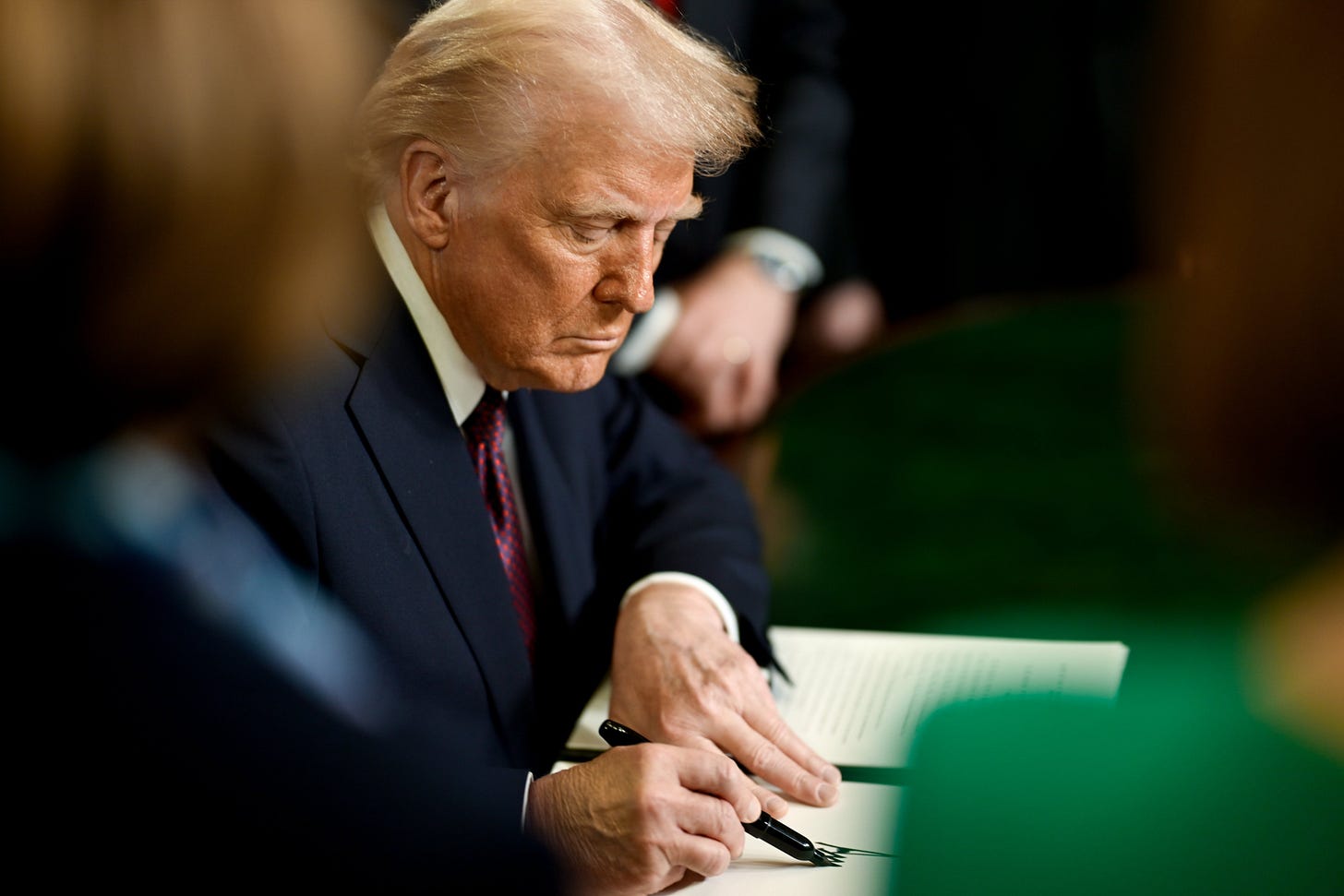
President Trump signs executive orders on January 20, 2025. White House via X
President Trump will undoubtedly continue to implement Project 2025 as he enters the second year of his second term. Westerners will, in turn, continue to rise up and defend the existence of public land. But what will those lands contain if Project 2025 is brought to fruition? Let this report be a warning to those who care about public lands: opposing the sale of public lands is not enough—if the Trump administration and Heritage Foundation have their way, our public lands will be effectively privatized by the end of Trump’s presidency in 2029. This will be achieved through the gutting of federal agencies, the issuance of long-term logging and drilling leases, and the permanent destruction of habitat by the proliferation of clear cuts, well pads, and mines.